
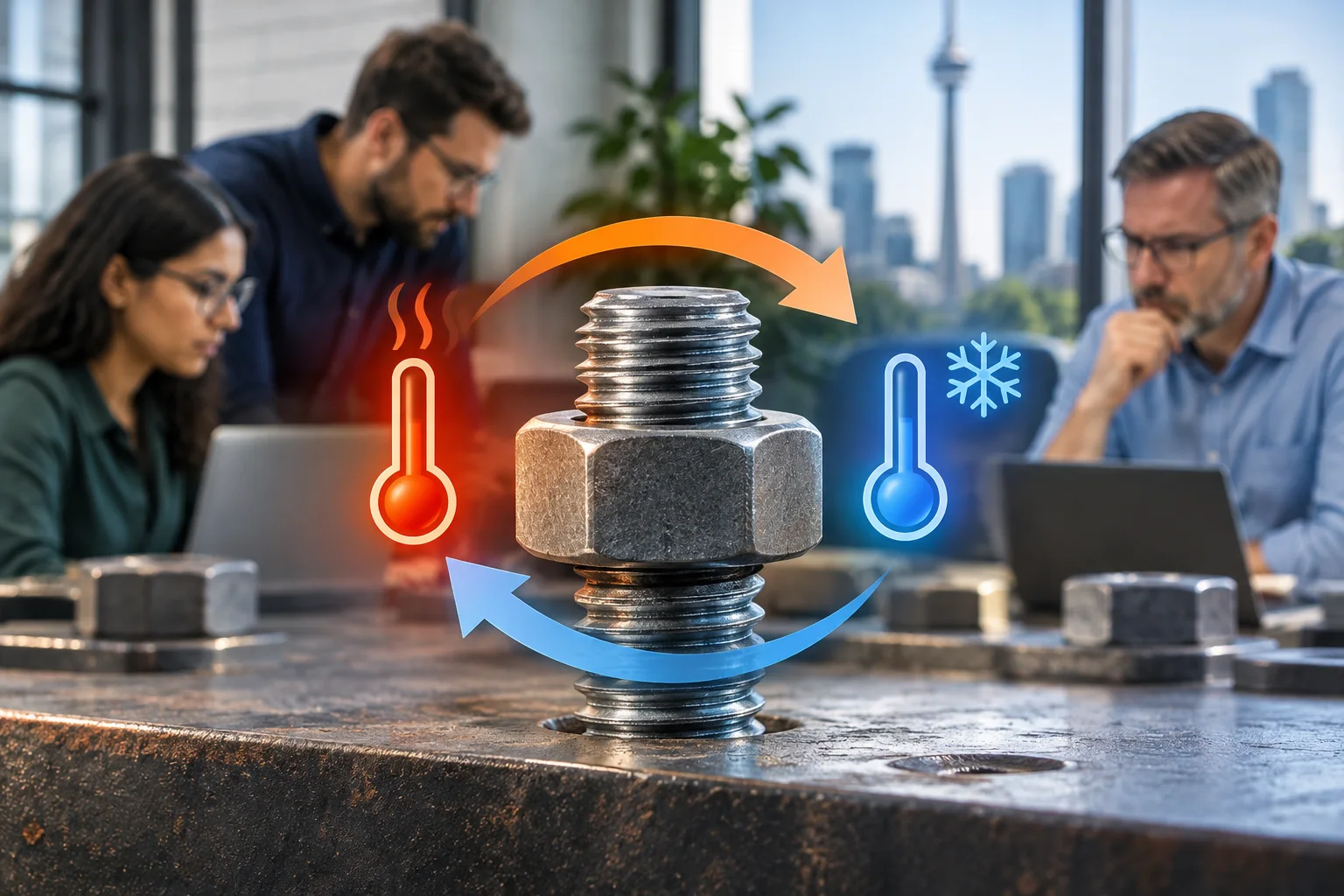
A screw that turns easily during installation can be stubborn months later, even if nobody has tightened it. Repeated heating and cooling can contribute, but not because metal grows a little more with each cycle. Within its elastic range, metal generally returns to its original dimensions when it returns to its starting temperature. What may not return to its original condition is the contact surface. Wear, corrosion or permanent deformation can leave two parts harder to separate. For businesses maintaining servers, network cabinets and other IT equipment, that distinction matters: a stuck screw calls for a different response than a loose connection.
What changes when two fitted parts heat up?
Most metals expand when heated and contract when cooled. A hole in a uniformly heated metal plate generally gets larger, not smaller: the material around the opening expands along with the rest of the plate. If a screw and its threaded hole are made of similar materials and warm evenly, their dimensions change in roughly the same proportion. There is no automatic tightening effect.
Real assemblies rarely warm evenly. A steel screw in an aluminium housing, for example, may remain relatively cool while the surrounding housing warms. The opening can expand relative to the screw, temporarily increasing clearance. If the screw heats first instead, clearance can decrease. There is also a change to consider along the length of the screw: expansion of the parts held under its head can stretch it further and increase clamping force. Which effect matters depends on the materials, geometry and temperature of each part.
Why the resistance can persist after cooling
Small movements can damage the contact surfaces
Two parts do not need to move far enough for anyone to see them shift. Repeated differences in expansion can cause tiny sliding movements where loaded surfaces meet. This wear process, called fretting, can produce fine debris. If particles oxidize and collect in a close-fitting joint, they can interfere with movement. On disassembly, the technician must overcome more than the friction between the original clean surfaces.
Moisture can turn a close fit into a corroded joint
When a surface cools below the dew point of the surrounding air, water can condense on it. Repeated condensation can support corrosion on susceptible metals. Some corrosion products occupy more space than the metal consumed, so deposits can crowd the narrow clearance between threads. Dissimilar metals in electrical contact can also undergo galvanic corrosion when moisture containing dissolved salts provides a conductive path. Heating and cooling alone do not cause this form of corrosion; the environment is part of the explanation.
Pressure can leave a permanent change in shape
If expansion is constrained, the load at a small contact point may be enough to deform a softer material permanently. A damaged thread can then catch on its mating thread even at room temperature. Elsewhere, the same physical process can have the opposite effect: if a soft layer beneath a screw head compresses permanently, the screw can lose tension. Temperature history is a clue, not proof that a joint has become tighter.
Hard to turn does not mean securely fastened
Breakaway torque is the turning effort needed to start a stationary fastener moving. Preload is the tension in the installed fastener that helps clamp the assembly together. The two are related, but they are not interchangeable. A corroded screw can have high breakaway torque while providing too little clamping force. Conversely, a properly installed fastener may resist removal because the manufacturer specified a locking feature, not because the equipment has overheated.
This distinction is particularly important for electrical terminals. Feeling resistance at a terminal screw does not establish that the conductor is securely clamped or that the connection is electrically sound. If staff notice discolouration, melted insulation or a burning smell, treat it as an equipment safety issue rather than a maintenance task for the office. Keep people clear and follow the site's electrical safety procedure.
What to do when a fastener will not move
- Check what the fastener is designed to do. Consult the service guide for the exact model. Some cover screws are captive: they release the cover but remain attached to it. Trying to extract one completely can damage an otherwise serviceable panel.
- Protect the service before opening the equipment. For a production server or network appliance, identify who depends on it, arrange a maintenance window and confirm the recovery plan. Follow manufacturer instructions for shutdown, isolation and cooling. Leave power supplies and other assemblies not intended for field service closed.
- Use the specified tool and stop before causing damage. A driver that almost fits can strip the recess before the screw starts to turn. If the head begins to deform, the mounting insert spins or the panel bends, stop. Do not apply a torch, penetrating oil or improvised leverage to IT equipment.
- Inspect before reassembly. A qualified technician should check the mating threads as well as the removed screw. Replacing a damaged screw does not repair a stripped insert. Use the approved replacement hardware and follow the specified torque and lubrication condition; adding lubricant can change the clamping load produced by a given installation torque.
Planning hardware maintenance for a GTA business
Consider a network cabinet near a loading entrance at a Vaughan warehouse. In winter, equipment brought inside from a cold vehicle can remain colder than the indoor air long after the delivery is complete. Follow the manufacturer's acclimatization guidance before applying power. For equipment already in service, check whether the cabinet location exposes it to moisture or obstructs airflow. A room thermostat across the building tells you little about conditions at the equipment intake.
For businesses arranging IT support in Toronto and across the GTA, the practical question is what happens if a routine repair cannot be completed on schedule. Document which switches carry VoIP services, where current firewall configurations are backed up and who can authorize a replacement. Planning around these dependencies can keep a seized fastener from turning a short maintenance window into an extended interruption.
TASProvider provides managed IT services in Toronto and across the GTA, including server management, network support and business continuity planning. If access to one aging device could delay recovery for your whole office, ask TASProvider to review its maintenance requirements, service dependencies and replacement options before the next shutdown.
Venerdì, Novembre 27, 2026
