
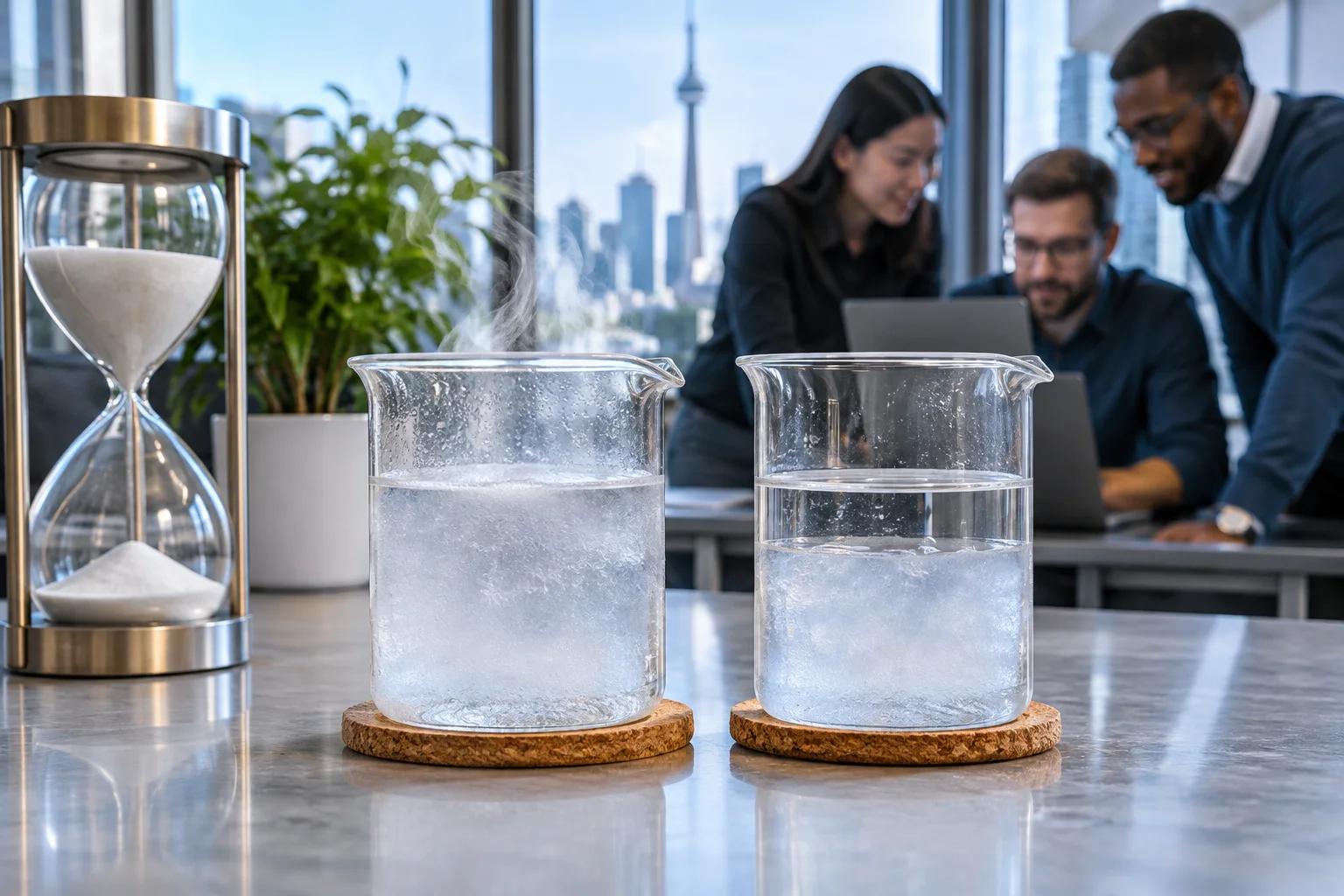
Hot water can sometimes form ice before cooler water placed in the same freezer. This observation, known as the Mpemba effect, is not a rule that hot water freezes faster. Warmer water has more heat to lose, but it may also evaporate more, circulate differently or begin forming ice at a different temperature. Whether the warmer sample finishes first depends partly on what you mean by frozen. A first crystal, a sheet of surface ice and a solid block are three different finish lines.
Why cooler water usually has the advantage
Imagine two equal masses of water in identical containers. If the only relevant difference is their starting temperature, the warmer sample has to shed extra heat just to reach the cooler sample’s starting point. A larger temperature difference between the hot water and the freezer air can make the hot water lose heat faster at first. But closing a gap quickly is not the same as overtaking.
The useful question is this: when the warmer sample reaches the other sample’s starting temperature, is it otherwise in the same state? Perhaps some water has evaporated. The base of its container might now sit directly on the freezer shelf rather than on frost. Even if a thermometer shows the same reading, the water near the surface and the water at the bottom may be at different temperatures. Those differences can affect what happens next.
What does it mean for water to freeze first?
At ordinary atmospheric pressure, the freezing point of pure water is approximately 0°C. That does not mean an entire cup becomes ice the moment a thermometer reads zero. Water can remain liquid below its freezing point, a condition called supercooling. To start freezing, it needs a stable crystal to form. A small particle or an irregularity on the container wall can provide a place for that process to begin.
Suppose the initially cooler cup reaches 0°C first but continues to supercool. The initially warmer cup reaches 0°C later, then starts forming ice with less supercooling. On a clock measuring time to first ice, the warmer cup wins. On a clock measuring time to 0°C, it loses. Neither observation tells you which cup will freeze solid first: after crystals appear, substantial heat still has to leave as the remaining liquid turns to ice.
Three ways the setup can change the result
1. Evaporation changes the amount of water left
In an open container, hot water generally evaporates more rapidly at the outset. Evaporation carries energy away and leaves less water to freeze. If you weigh each filled container before and after a trial, a difference in mass can help you assess whether evaporation mattered. It cannot, by itself, prove that evaporation decided the outcome. A result from open dishes also need not carry over to covered containers, where moisture loss is limited.
2. Water circulates as it cools
A cup of cooling water is rarely at one uniform temperature. As temperature differences change the water’s density, water moves within the cup, transporting heat between its interior and its colder boundaries. The circulation pattern depends on the shape of the vessel and where heat is escaping. A probe beside the wall can therefore give a different account of the cooling process from one at the centre. Comparing readings taken at different depths can make an apparent reversal difficult to interpret.
3. The container’s contact with the freezer matters
On a frosty shelf, a warm container can melt the frost beneath it. If it then makes better thermal contact with a cold shelf, heat can escape more readily through its base. The two cups may be in the same freezer without experiencing the same cooling conditions. This explanation is relevant to a frosty support; it is not an explanation for every experiment, especially one in which both vessels sit on a dry rack.
How to make a useful comparison
If you try a small demonstration, use warm tap water rather than boiling water and choose matching, freezer-safe containers rated for the starting temperature. Avoid glass that could crack under thermal stress, and keep the samples away from stored food. The aim is not to make the warmer sample win. It is to find out what your particular setup measures.
- Choose the endpoint in advance. First visible surface ice is easier to observe than complete solidification. Record it as surface ice, not as proof that the whole sample froze.
- Match the starting conditions. Use water from the same source and equal starting masses. Record both temperatures immediately before putting the containers in the freezer.
- Control placement and observation. Use the same shelf and support surface. If you use temperature probes, place them at matching depths. Check both cups at the same intervals and note if both first show ice at the same check.
- Repeat with positions reversed. A cup near a cold-air outlet may have an advantage. Keep results from every run, including ties, rather than selecting the most surprising one.
If the cooler sample freezes first each time, your observations are useful: they show that this setup did not produce a reversal. If the warmer one forms ice first, you have a reason to investigate, not a universal shortcut for making ice. Change one factor in the next set of trials rather than changing the container, shelf and water quantity together.
A practical lesson for Toronto businesses: define the finish line
The same measurement distinction matters in data backup and disaster recovery. A server starting after a restore is a milestone, much like the first ice crystal. For a Vaughan distributor, however, recovery may not be complete until an employee can sign in, find a recent order and print its shipping paperwork. Timing only the server restart leaves out the part that determines whether the business can ship.
When reviewing a recovery plan, identify a critical task, agree on how recent the recovered data must be and test the task from a user’s workstation. For small and medium-sized businesses in Toronto and across the GTA, TASProvider offers managed IT services, business IT support and IT consulting. Contact TASProvider to review your backup and recovery plan against a finish line your team can actually verify.
Miércoles, Noviembre 25, 2026
