
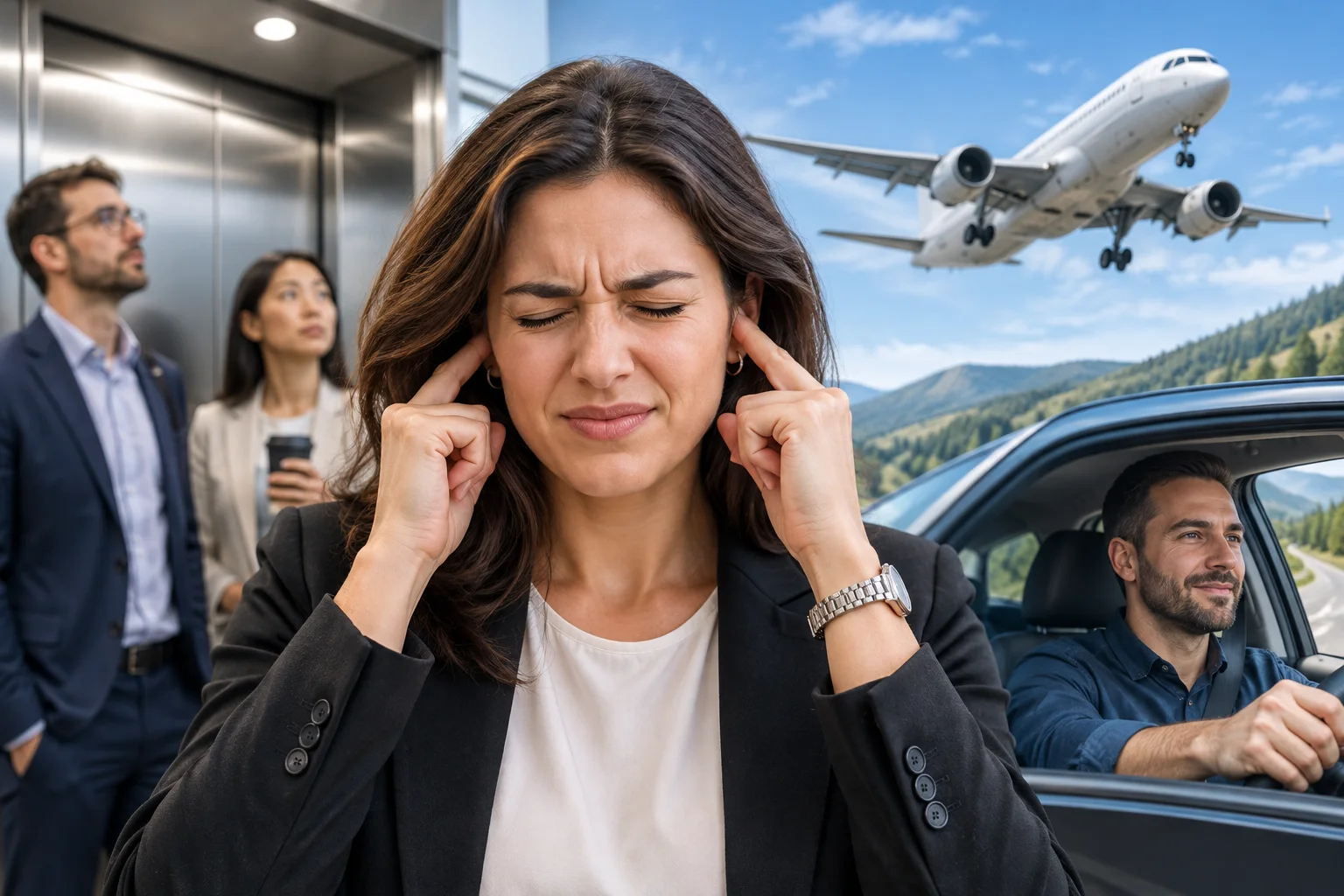
Your ears sometimes pop in elevators, airplanes and hilly terrain because the air pressure around you changes faster than the pressure inside your middle ear. The pop is usually the sound or sensation of those pressures equalizing. It is not the speed of the elevator, aircraft or car itself that matters. What counts is how quickly the surrounding pressure changes and whether your ears can keep up. That distinction explains why a short elevator ride to a Toronto meeting can make your ears click, while a much longer drive on level ground may not.
What actually happens when an ear pops?
The eardrum is a thin membrane separating the outer ear canal from the air-filled middle ear. Air in the outer ear canal is exposed to the environment, so its pressure changes along with the air around you. The middle ear has a different route to the outside world: a narrow passage called the eustachian tube, which connects it to the back of the nose.
Normally, the tube stays closed much of the time and opens briefly when you swallow or yawn. If pressure differs on the two sides of the eardrum, the membrane bows slightly. You may notice fullness, discomfort or muffled sound. When the tube opens, a small amount of air can move in or out of the middle ear. As the pressure difference eases, you may feel a pop and notice that voices sound clear again. One ear may clear before the other because each middle ear has its own tube.
Why elevators, flights and hill drives feel different
Elevators: a small change over a short time
Air pressure generally decreases with height. A high-rise elevator can cover enough vertical distance between the lobby and an upper floor for you to notice the change before you naturally swallow. The sensation is often brief. If your ears click just as the doors open, it does not necessarily mean the elevator jolted or stopped too sharply. You may simply have swallowed at the end of the ride.
Airplanes: cabin pressure changes during the flight
A passenger aircraft has a pressurized cabin, but pressurized does not mean the cabin stays at the same pressure from gate to gate. As the aircraft climbs, cabin pressure generally drops, and air in the middle ear can escape through the eustachian tube. During descent, cabin pressure rises again. Now air needs to enter the middle ear to balance the pressure across the eardrum.
Descent is often the more uncomfortable part because air does not always enter as readily as it escapes. For someone flying into Toronto Pearson, the useful time to start swallowing or yawning is when the descent begins, not when the wheels touch the runway. If you sleep through descent, you may swallow less often and wake up with ears that feel blocked.
Hills: elevation matters more than road speed
On a drive through the Niagara Escarpment, the road can gain or lose elevation gradually enough that your ears adjust without a noticeable pop. A steeper stretch can make the change more apparent. A useful comparison is a fast journey on a flat highway: despite travelling faster, you may feel nothing because you have not changed elevation enough to create a noticeable pressure difference.
Practical ways to ease ear pressure
The aim is to give the eustachian tubes opportunities to open, not to produce the loudest possible pop. Start with gentle movements and use them early, particularly if you know your ears tend to bother you on landing.
- Swallow, sip or yawn. A few sips of water encourage repeated swallowing. Chewing gum can serve the same purpose if it is comfortable for you.
- Try pinching your nose and swallowing. If ordinary swallowing does not help, gently close your nostrils and swallow once. Release your nose and see whether the fullness eases.
- Avoid force. Do not repeatedly blow hard against a pinched nose to make a stubborn ear pop. Stop any pressure-clearing manoeuvre if it hurts.
- Keep your attention on the road. If you are driving, stick to simple swallowing or yawning. Pull over safely if discomfort or dizziness interferes with your ability to drive.
A cold, nasal allergies or congestion can make the opening of the eustachian tube swell, which helps explain why a familiar journey may feel different from one week to the next. If you are very congested or have an ear infection and expect to fly, ask a healthcare professional whether postponing the trip is advisable. Check with a pharmacist or clinician before using a decongestant specifically for travel; these medicines are not suitable for everyone.
When a blocked ear needs medical attention
A brief pop followed by relief is different from persistent pain or a significant change in hearing. Seek prompt medical care for severe ear pain, bleeding or fluid draining from the ear, or pronounced dizziness after a pressure change. Sudden hearing loss deserves urgent assessment, even if it feels like an ordinary blocked ear. If mild fullness or muffled hearing does not resolve after the trip, or the problem keeps recurring, arrange an assessment rather than trying increasingly forceful ways to clear it.
A travel checklist for GTA business teams
For business owners and staff travelling between client sites, distinguish ear discomfort from an audio problem before an important call. If nearby conversation and your headset both sound muffled just after landing, do not immediately turn up the volume. If conversation sounds normal but callers cannot hear you, check the selected microphone and make a test call. For meetings that cannot wait, enabling captions where available can help you follow the discussion without raising headset volume.
Ear pressure calls for gentle equalization; reliable work on the road calls for preparation. If your team regularly moves between the office, client sites and airports, contact TASProvider about managed IT services in Toronto and across the GTA. TASProvider can help you review Microsoft 365 access, VPN configuration and VoIP services before departure, so travellers know how to connect securely, place a business call and reach IT support when they need it.
Dilluns, novembre 23, 2026
