
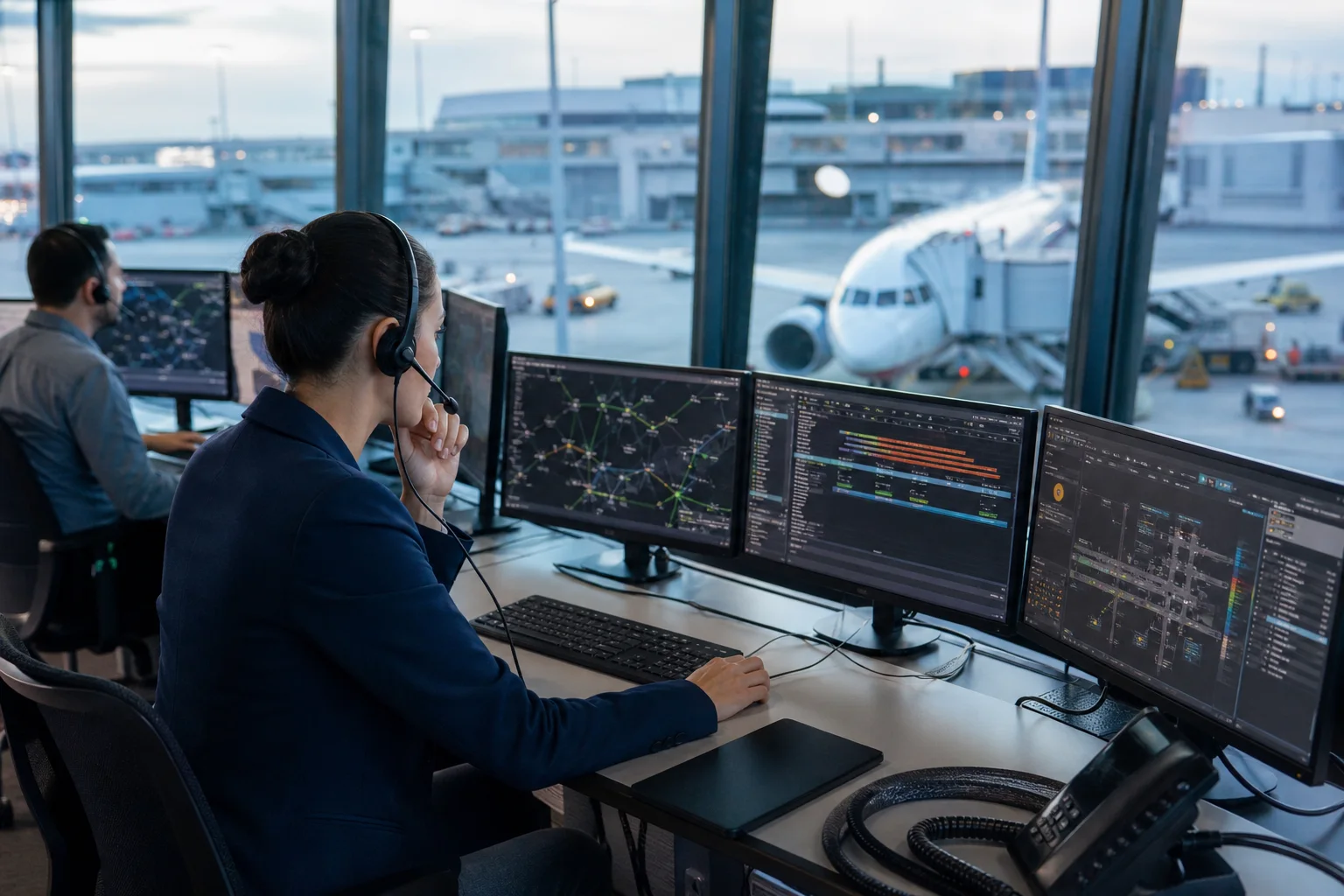
Clear skies at your departure and arrival airports do not guarantee an on-time flight. Commercial aviation operates as an interconnected network, so conditions hundreds or thousands of kilometres away can affect your aircraft, crew, route, or departure slot. Understanding these dependencies can help business travellers plan more effectively and help organizations build realistic business continuity procedures.
Weather Elsewhere Can Disrupt Your Flight
Your local airport may have perfect weather while storms, strong winds, snow, fog, or turbulence affect another part of the aviation network. The aircraft assigned to your flight may be arriving from an affected city. If that inbound flight is late, your departure may also be delayed.
Weather can also restrict the route between airports. Thunderstorms along a flight path may require aircraft to fly around hazardous areas. These diversions consume additional fuel, increase flight time, and place more traffic into the remaining usable airspace.
Weather delays can travel through the network
Airlines generally use aircraft for several flights each day. Crews also move between cities as part of scheduled rotations. A weather disruption early in the day can therefore affect later flights in places where conditions remain clear.
This is sometimes described as a cascading delay. Its effects may include:
- An aircraft arriving late for its next scheduled departure
- A flight crew missing a connection or reaching regulated duty limits
- Ground teams handling several delayed aircraft at once
- Passengers and checked baggage requiring new connections
- Airport gates remaining occupied longer than planned
Air Traffic Control Manages the Entire System
Air traffic control must maintain safe separation between aircraft and balance demand with the available capacity of airports and airspace. When congestion, severe weather, equipment issues, or runway restrictions reduce that capacity, traffic managers may slow departures before aircraft enter an overloaded area.
As a result, your flight might wait at a sunny Toronto airport because its route passes through constrained airspace or because the destination cannot safely accept aircraft at the usual rate. Holding the flight on the ground can be safer and more efficient than having it circle in the air.
Departure slots and flow restrictions
A flight may receive a specific departure time as part of an air traffic flow-management measure. The assigned time coordinates traffic entering busy sectors and airports. Missing that window can lead to another wait while controllers identify a safe opening.
These restrictions are not always visible to passengers. The terminal windows may show clear skies, but the operational issue could be far beyond the airport.
Your Aircraft May Be Delayed on an Earlier Flight
Airlines schedule aircraft carefully to maximize fleet use. The plane operating an evening flight may already have completed several trips that day. Delays can accumulate during that sequence.
Common causes include:
- Late arrival from a previous destination
- Additional maintenance inspections or repairs
- Extended boarding, cleaning, catering, or baggage handling
- A gate conflict caused by another delayed aircraft
- Refuelling or load-planning changes
- De-icing at an earlier airport
Airlines may substitute another aircraft when one is available, but this is not always practical. A replacement must be in the right location, suitable for the route, ready for service, and compatible with available crews and gates.
Crew Availability Can Affect Departure Times
Pilots and cabin crew work under duty-time and rest requirements intended to manage fatigue. A delayed inbound flight, missed crew connection, or unexpected operational change can leave an airline without a legally available crew for the next departure.
Reserve personnel may solve the problem, but replacements must be qualified for the aircraft and able to reach the airport. If a delay extends far enough, the airline may need to assign a new crew or reschedule the flight.
Maintenance Is Not Always Planned
Aircraft undergo scheduled maintenance, inspections, and checks. Flight crews and technicians may also identify issues during routine operations that require assessment before departure. Even a relatively minor problem can delay a flight while qualified personnel inspect the aircraft, complete approved work, document the result, or obtain a replacement part.
A maintenance delay does not necessarily mean the aircraft experienced a major failure. Aviation procedures require potential issues to be evaluated according to applicable operational and maintenance requirements. This work can take time, particularly when specialized technicians or parts are not immediately available.
Airport Operations Involve More Than Weather
An airport can experience reduced capacity on a clear day. Runway inspections, construction, disabled aircraft, security events, staffing constraints, or equipment problems may temporarily limit operations.
Flights also depend on coordinated ground services, including:
- Gate and bridge availability
- Baggage loading and unloading
- Aircraft cleaning and catering
- Passenger assistance and boarding
- Fuel delivery
- Pushback equipment and ramp personnel
If one critical task is incomplete, the aircraft may not be ready to depart. During peak periods, a short disruption can affect multiple flights because gates, crews, and equipment are already heavily scheduled.
Passenger, Baggage, and Security Issues Can Cause Delays
Boarding can take longer when passengers require assistance, travel documents need verification, or carry-on baggage exceeds available cabin space. If a checked-in passenger does not board, additional procedures may be required before departure. Security or customs matters can also interrupt normal operations.
Airlines sometimes hold a flight briefly for connecting passengers or bags, especially when many travellers are arriving from the same delayed service. The decision depends on operational circumstances and the effect on later flights.
Why Airlines Cannot Always Make Up the Time
Schedules may include some time to absorb ordinary operational variation, and a flight may recover part of a delay during travel. However, aircraft cannot simply fly faster without considering fuel use, air traffic instructions, routing, weather, and operating limits.
A late aircraft may also reach its destination without an available gate. Even after landing, passengers can remain on board until ground personnel and facilities are ready.
Practical Planning for Business Travellers
Flight disruption cannot be eliminated, but businesses can reduce its operational impact. Consider these practical measures:
- Choose earlier flights when possible: Delays often accumulate as aircraft and crews complete multiple daily segments.
- Allow connection time: Avoid itineraries that leave no margin for changing terminals, security procedures, or inbound delays.
- Monitor the inbound aircraft: Airline applications and flight-tracking services may show whether the assigned aircraft is running late.
- Keep essential items accessible: Carry medications, chargers, identification, and critical work materials in hand luggage where permitted.
- Prepare for remote work: Use secured devices, approved cloud applications, multifactor authentication, and a trusted connection.
- Avoid unsecured public Wi-Fi: Use a managed mobile connection or an organization-approved VPN when handling business information.
- Build schedule flexibility: Arrive ahead of important meetings and maintain a remote participation option.
Flight Delays Are a Business Continuity Issue
Travel delays illustrate a broader operational lesson: visible local conditions do not reveal every upstream dependency. A company may have a functioning office while an internet provider, cloud platform, supplier, employee, or third-party service experiences disruption elsewhere.
Effective business continuity planning identifies these dependencies and prepares alternatives. Secure cloud IT services, Microsoft 365 services, managed devices, data backup and disaster recovery, VoIP services, and documented remote-work procedures can help employees remain productive when travel plans change.
TASProvider helps organizations across Toronto and the GTA strengthen technology resilience through managed IT services, cybersecurity, cloud solutions, business IT support, and IT consulting. Contact TASProvider to review how your team securely accesses systems and communications when travel or other unexpected disruptions keep employees away from the office.
subota, studeni 14, 2026
