
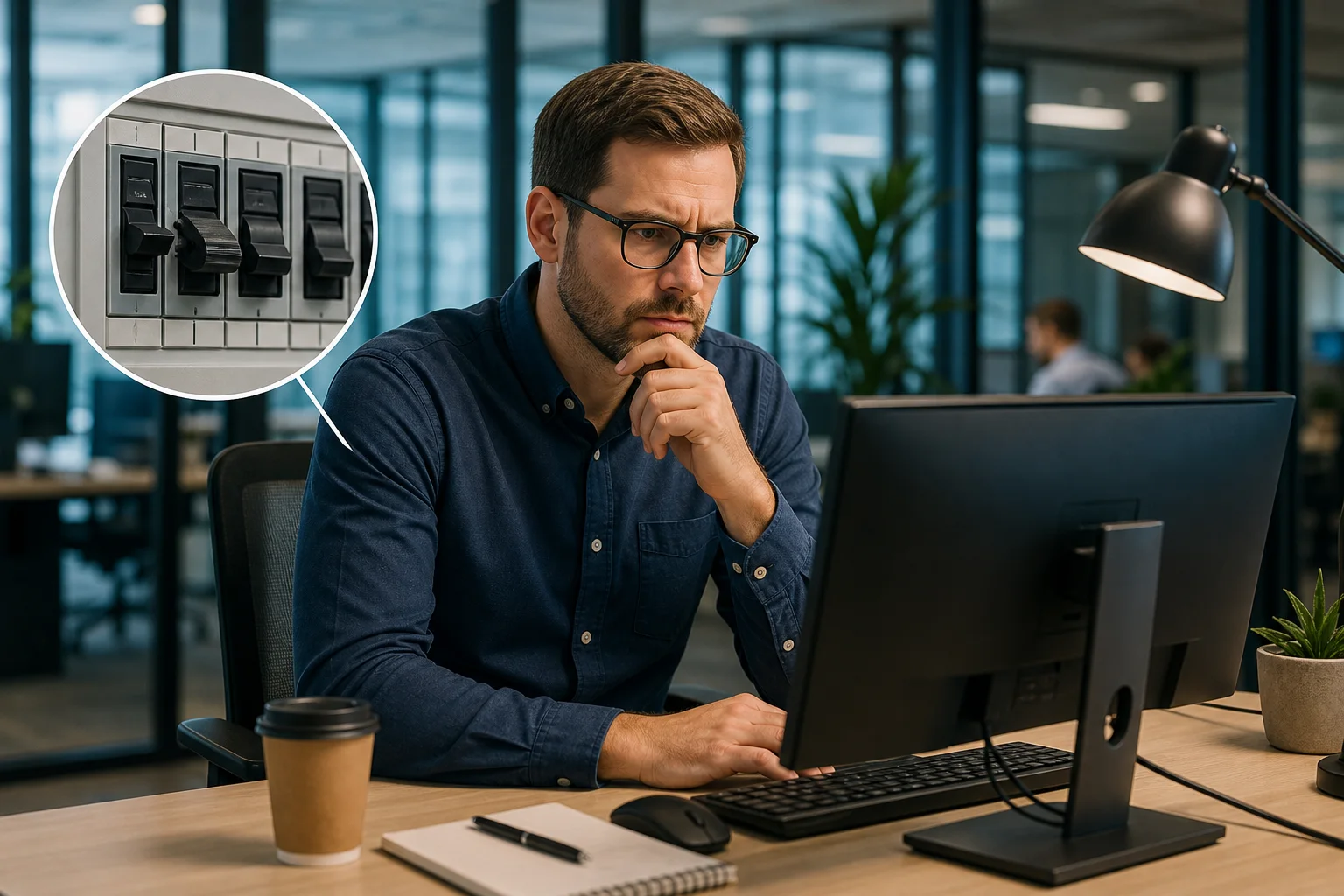
An appliance that trips a circuit breaker only occasionally can be harder to diagnose than one that fails every time. Intermittent trips usually occur because electrical demand, operating conditions, or a developing fault changes from one use to the next. Although resetting the breaker may restore power, repeated trips should not be ignored. A breaker is a safety device designed to interrupt current when it detects an overload, short circuit, or another potentially unsafe condition.
For businesses, intermittent breaker trips can also affect computers, servers, network equipment, phone systems, and other essential technology. Understanding the likely causes—and knowing when to involve a licensed electrician—can help protect people, equipment, and business operations.
Why Breaker Trips Can Be Intermittent
An appliance does not always draw the same amount of electricity. Power consumption can change during startup, heating, cooling, pumping, or other operating cycles. Conditions elsewhere on the circuit may also vary throughout the day.
For example, a microwave may work normally when it is the only major load on a circuit but trip the breaker when a coffee maker or space heater is operating at the same time. A refrigerator may run without trouble during its normal cycle yet cause a trip when its compressor starts. These changing conditions explain why a problem may appear random even when there is an identifiable cause.
Common Reasons an Appliance Trips a Breaker Sometimes
1. Temporary Circuit Overloads
A circuit overload occurs when connected devices require more current than the circuit is designed to carry. The appliance itself may be operating correctly, but the combined load can become too high.
Common examples include:
- A kettle, toaster, and microwave operating on the same kitchen circuit
- A space heater sharing a circuit with office computers or printers
- Cleaning equipment being connected to an already busy receptacle circuit
- A high-draw appliance switching on while other devices are running
The breaker may trip only during these overlapping periods. Avoid repeatedly moving devices between outlets without confirming which circuit supplies them, because multiple outlets may share the same breaker.
2. High Startup Current
Appliances with motors or compressors can draw more current when starting than while running. Refrigerators, freezers, air conditioners, pumps, and some power tools are common examples.
A healthy electrical system should accommodate normal startup demand when the appliance and circuit are appropriately matched. However, an aging motor, mechanical resistance, low voltage, a heavily loaded circuit, or an unsuitable breaker can make occasional startup trips more likely. A qualified technician can evaluate the appliance, while a licensed electrician can assess the circuit and breaker.
3. A Developing Appliance Fault
Internal components can deteriorate gradually. Damaged insulation, loose wiring, worn motors, failing heating elements, moisture, or contaminated components may create a fault only under specific conditions.
A heating element, for example, may develop a defect that becomes apparent only after it reaches a certain temperature. A power cord may fail only when bent in a particular direction. These problems should be treated seriously because intermittent behaviour can become a complete failure or create a shock and fire hazard.
4. Ground Fault or Moisture
Ground-fault circuit interrupter (GFCI) protection is commonly used where electricity may be exposed to moisture. A GFCI breaker or receptacle can trip when current follows an unintended path to ground.
Moisture around an appliance, damaged cords, internal leakage, outdoor connections, or condensation may cause occasional trips. The issue may appear only after cleaning, wet weather, a defrost cycle, or operation in a humid area. Do not bypass GFCI protection or use an ungrounded adapter to keep the appliance running.
5. Arc-Fault Detection
Some circuits use arc-fault circuit interrupter (AFCI) protection. These devices are designed to respond to electrical arcing that may result from damaged conductors, loose connections, defective cords, or internal appliance problems.
Because arcing can be intermittent, an AFCI trip may not happen during every use. A licensed electrician should inspect repeated AFCI trips rather than replacing the breaker or assuming the protective device is overly sensitive.
6. Loose or Damaged Electrical Connections
A loose receptacle, terminal, breaker connection, or appliance plug can create heat and unstable electrical behaviour. Movement, vibration, or temperature changes may make the problem appear and disappear.
Warning signs include:
- A warm or discoloured outlet cover
- Buzzing, crackling, or sizzling sounds
- A loose-fitting plug
- A burning smell
- Flickering lights when the appliance starts
- Visible damage to a cord, plug, or receptacle
If any of these signs are present, stop using the appliance and circuit. Do not open an electrical panel or attempt internal repairs unless you are properly qualified.
7. A Worn or Incorrect Breaker
Breakers can wear out or develop problems, but they should not be assumed to be defective simply because they trip. The breaker may be responding correctly to a hidden overload or fault.
Only a licensed electrician should determine whether the breaker is suitable for the circuit and functioning properly. Installing a higher-rated breaker without confirming the conductor size and circuit design can create a serious overheating hazard.
What to Record Before Calling for Service
Intermittent problems are easier to diagnose when there is a clear record of what happened. Note:
- Which appliance was operating
- Whether the trip occurred at startup or later in the cycle
- What other equipment was running at the time
- Whether the breaker, GFCI, or AFCI device tripped
- Any unusual sounds, heat, odours, or flickering
- Whether weather, moisture, or cleaning may have been involved
- How frequently the event occurs
Do not intentionally recreate a suspected fault. The purpose of the record is to document normal observations, not to stress the appliance or electrical system.
What You Should Do After a Breaker Trips
- Turn off or unplug the appliance if it is safe to do so. Stop immediately if you notice smoke, heat, visible damage, or a burning smell.
- Check for obvious overloading. Identify other high-demand equipment on the affected circuit without opening the panel or removing electrical covers.
- Reset the breaker only when conditions appear safe. Follow the breaker manufacturer’s operating method. Do not repeatedly reset a breaker that trips again.
- Keep the appliance out of service if it causes another trip. Arrange an assessment by an appropriate appliance technician or licensed electrician.
- Escalate urgent warning signs. Smoke, sparking, scorching, persistent odours, or unusual panel heat requires prompt professional attention. Contact emergency services when there is an immediate fire risk.
Protecting Business Technology from Power Problems
In an office, retail location, warehouse, or professional practice, a breaker trip can interrupt more than one appliance. Sudden power loss may disconnect workstations, network switches, firewalls, storage systems, VoIP phones, and internet equipment. It can also contribute to unsaved work, corrupted data, or prolonged downtime.
Business owners should keep high-demand appliances such as portable heaters and kitchen equipment away from circuits serving critical IT infrastructure where possible. A licensed electrician can review circuit capacity and separation. An experienced managed service provider can assess the technology side, including properly selected uninterruptible power supplies, equipment shutdown procedures, data backup and disaster recovery, and business continuity planning.
A UPS can provide temporary power and help supported equipment shut down correctly, but it does not repair overloaded wiring, defective appliances, or unsafe electrical conditions. Electrical faults must be addressed at their source.
When Professional Help Is Necessary
Contact a licensed electrician when a breaker trips repeatedly, the cause is unclear, multiple circuits are affected, or there are signs of heat, arcing, moisture, or damaged wiring. An appliance service professional may also be needed if testing indicates an internal appliance fault.
For organizations across the Greater Toronto Area, TASProvider helps reduce the operational impact of power-related interruptions through business IT support, network planning, cloud IT services, Microsoft 365 services, cybersecurity, and data backup and disaster recovery. TASProvider does not replace a licensed electrician, but our managed IT services Toronto team can help ensure critical systems are protected, monitored, and prepared for unexpected outages. Contact TASProvider to review your IT resilience and business continuity strategy.
Çərşənbə, Noyabr 4, 2026
